



















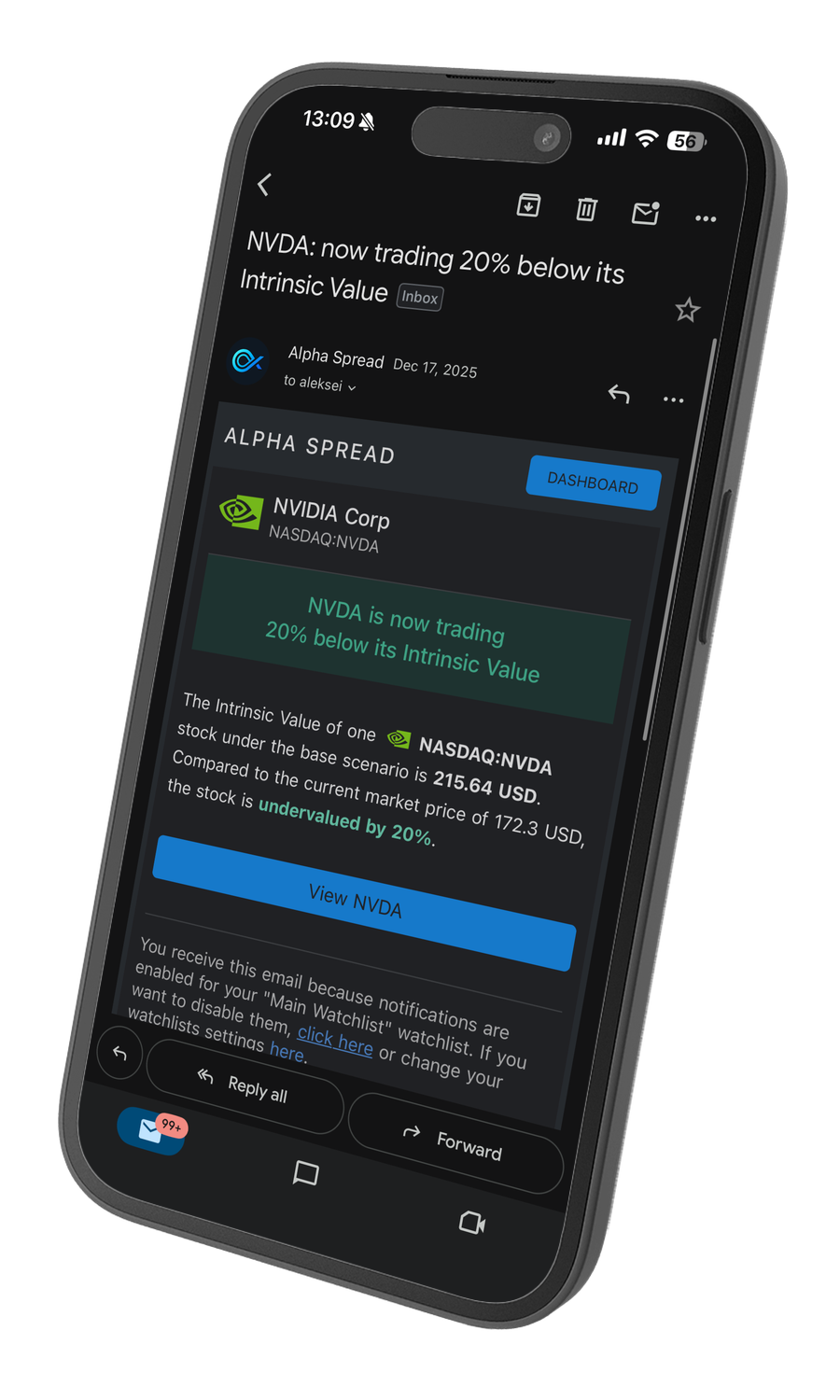




Is Amazon undervalued?
How We Measure Valuation Quality
and What the Results Mean
Valuation is only useful if it helps explain future outcomes. That's why we continuously run quality checks on our valuation signals across a broad universe of stocks and long history. Below is a plain-English explanation of the metrics we use, why they matter, and our latest global results.
What we test
At a high level, we test whether stocks that look undervalued by our models tend to deliver better forward returns than stocks that look overvalued.
To avoid "cherry-picking," we compute these metrics on a large sample and use robust statistics.
VIC: Valuation-Return Correlation
What it is: A rank correlation between our valuation signal and 12-month forward returns.
How to read it: undervalued ranks tend to outperform overvalued ranks. A positive correlation means the signal is directionally consistent across the cross-section, not just a few names.
Quintile Spread
What it is: The difference between the top 20% most undervalued and the bottom 20% most overvalued stocks, measured by their forward returns.
How to read it: This is an intuitive portfolio-style test: what happens if you buy undervalued and avoid overvalued?
Hit Rate
What it is: The share of cases where the valuation signal gets the direction right, from undervalued to positive forward return or overvalued to negative forward return.
How to read it: Above 50% indicates the signal is better than coin-flip directionally, even before position sizing or risk controls.
Note that a 100% hit rate is not realistic: an undervalued stock can become even more undervalued before it recovers, and vice versa.
Latest global results
| VIC (12M) | 0.3204 |
| Quintile Spread | 28.3% |
| Hit Rate | 65.1% |
Across a large sample, undervaluation identified by our models is associated with meaningfully better forward outcomes, the undervalued vs overvalued separation is large, and directional accuracy is strong.
Why these checks are trustworthy
Large sample: results aren't driven by a small number of hand-picked examples.
Forward-looking test: we evaluate using future returns, not in-sample fit.
Robust statistics: we reduce the influence of rare extreme events where appropriate.
Multiple lenses: we look at correlation, portfolio spreads, directional hit rate, tail risk, and cross-model agreement.
Bottom line
No valuation model predicts every stock, and markets are noisy. But a valuation signal is valuable if it is systematically informative across many stocks and many periods. These metrics are our way of holding the system accountable, and the latest results show strong, consistent evidence that the signal is real.